Kimi SEO
Kimi SEO is an open-source SEO analysis plugin for Kimi Code (Moonshot AI). It runs 25 sub-skills and 18 specialist agents in parallel across technical SEO, content quality (E-E-A-T), Schema.org markup, AI search optimization (GEO), local SEO, e-commerce, and international SEO. Every audit produces a prioritized action plan with testable recommendations grounded in primary-source guidance from Google.





Kimi SEO is a fork of
AgriciDaniel/claude-seo, adapted for Kimi Code (Moonshot AI). All credit for the original SEO workflow goes to @AgriciDaniel and the upstream contributors. Themainbranch tracks upstream releases; thekimibranch carries the Kimi rebrand and adaptations.
Why Kimi SEO
- AI-search first. Aligned with Google's AI Optimization Guide. Question-based citability scoring, primary-source evidence on llms.txt, IPTC
TrainedAlgorithmicMediafor AI-generated product images, agent-friendly page checks per web.dev. - Parallel execution. Full site audits spawn up to 15 specialist agents simultaneously. Site-level audits complete in minutes rather than hours.
- Falsifiable, not promotional. Every recommendation carries the first-principle observation it rests on, its dependency relationships, an explicit "how would we know this failed?" check, and a leading indicator. See Methodology.
Real results
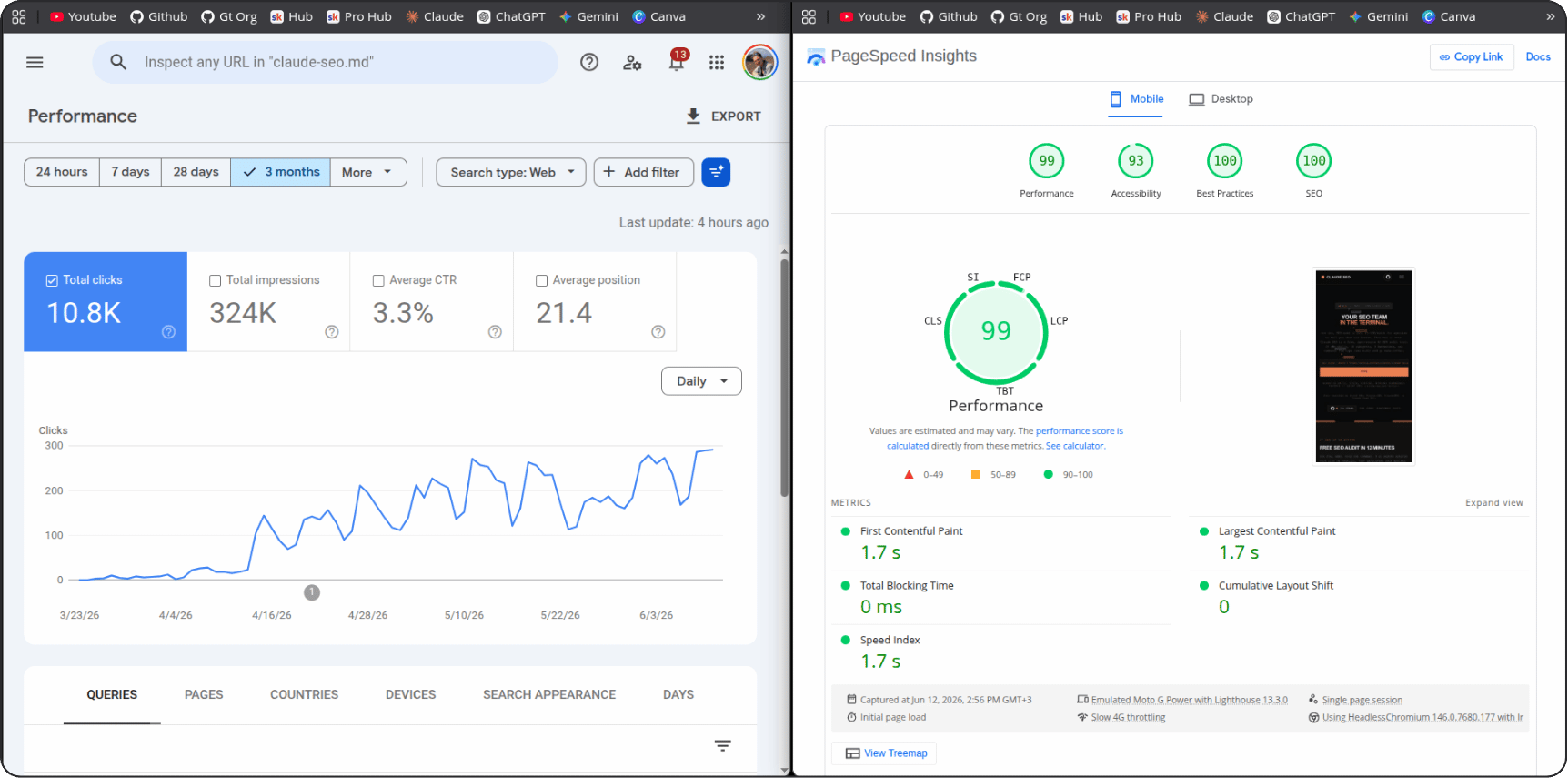
Google Search Console for a site started 23 March 2026 and run on this workflow: total clicks and impressions across its first three months, through 12 June 2026.
Who this is for
- SEO agencies running 5+ client sites. Replace quarterly deep audits with weekly automated runs. Same team capacity, 4× audit cadence, every recommendation comes with a falsifiability check the client can verify.
- In-house SEO leads at SaaS / publisher / e-commerce companies. Second-pair-of-eyes before executive reviews. Catches what GSC and Lighthouse hide: schema deprecation, AI-citability gaps, expired-domain heritage risk, parasite-SEO exposure, machine-translation drift.
- Freelance SEO consultants. Anchor day-one client scope with a 15-minute audit and a real 0-100 score. Win the engagement with concrete proof of value before you spend an hour writing the proposal.
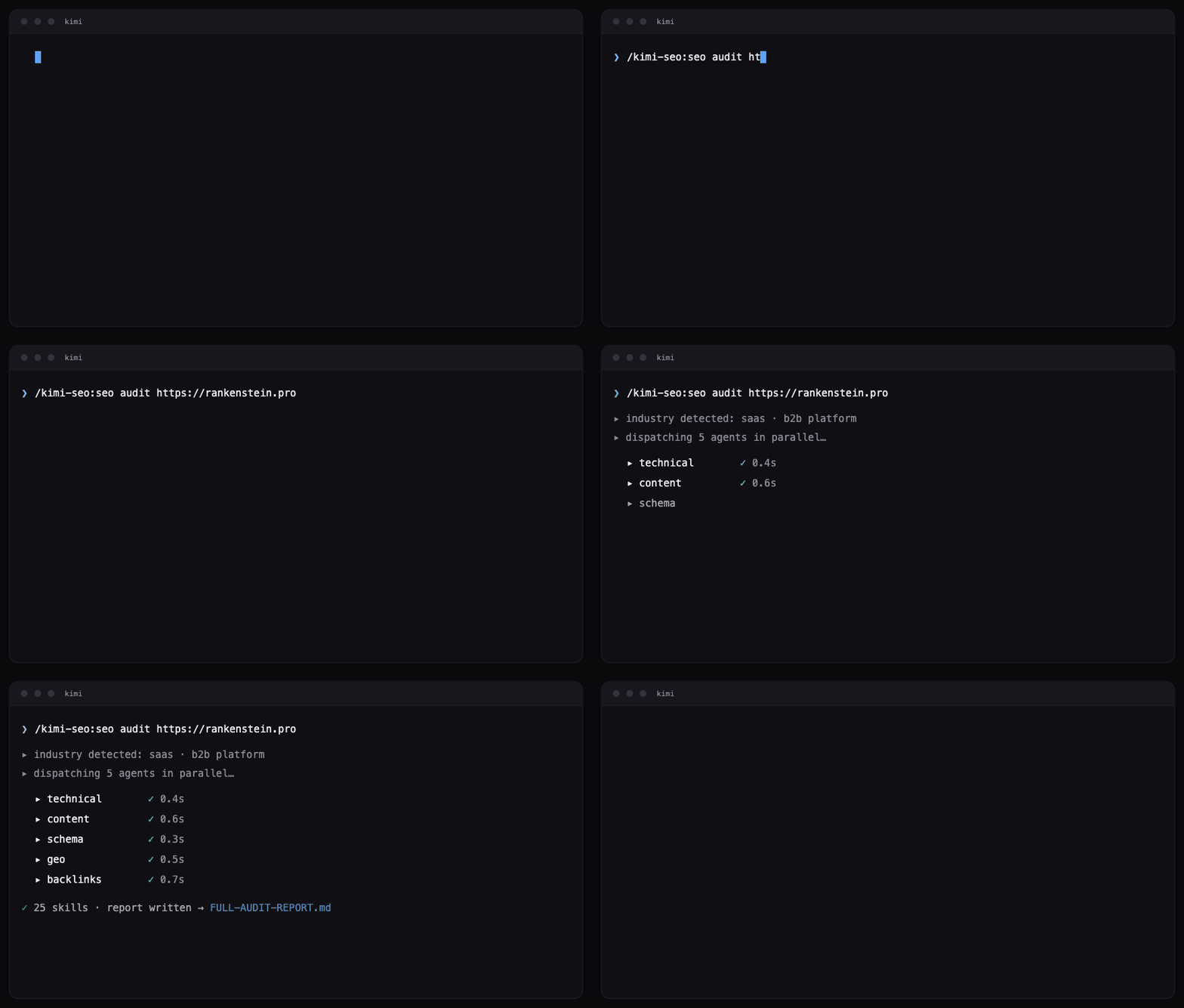
Run a full audit and watch parallel agents fan out across the site:
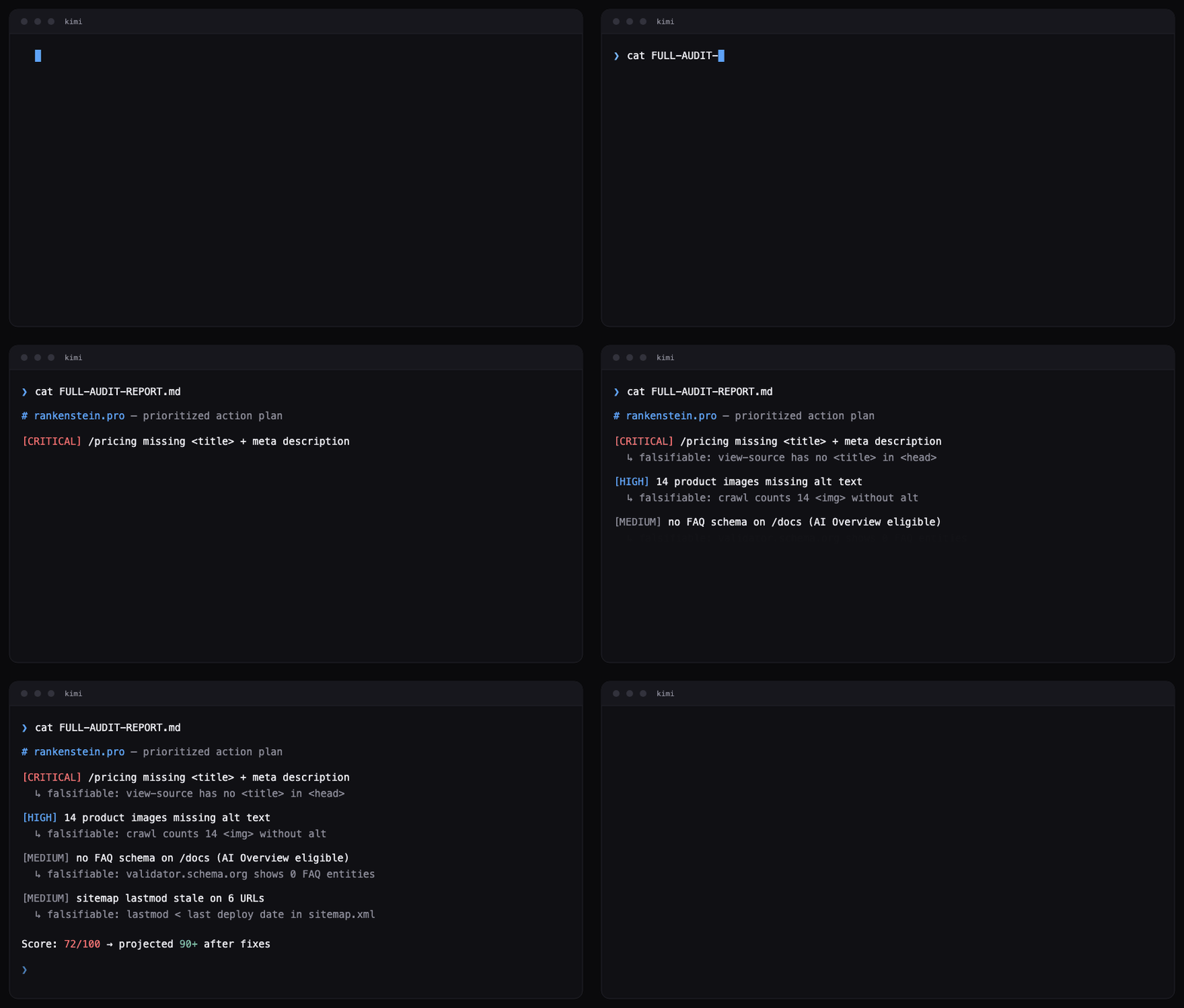
Table of Contents
- Who this is for
- Installation
- Quick Start
- Getting Started guide
- Commands
- Features
- Compared to manual / agency / commercial tools
- Use cases
- Sample Output
- Architecture
- Methodology
- Limitations
- Requirements
- Uninstall
- Extensions
- Ecosystem
- Documentation
- FAQ
- Community Contributors
- License
- Contributing
- Author
Installation
ℹ️ You are on the Kimi fork. The commands below install from
bentocodeing/kimi-seo— MIT, public releases, no membership required. Upstream project:AgriciDaniel/claude-seo.
Plugin Install (Kimi Code, recommended)
Inside Kimi Code, install this fork directly from GitHub:
/plugins install https://github.com/bentocodeing/kimi-seo
/reload
/kimi-seo:seo setup
The plugin manager copies the repo to Kimi Code's managed plugins directory and loads kimi.plugin.json: all 25 skills, the session-start orientation skill, and the schema-validation hook. /kimi-seo:seo setup is an explicit, one-time provisioning step for the isolated Python runtime.
Update: repeat the same /plugins install command, then /reload. Remove: /plugins remove kimi-seo. Both covered in the Installation Guide.
Manual Install (Unix / macOS / Linux)
For a git-checkout install into ~/.kimi-code/skills/ and ~/.agents/agents/:
git clone --depth 1 --branch kimi https://github.com/bentocodeing/kimi-seo.git
bash kimi-seo/install.sh
One-liner (curl, review then run)
curl -fsSL https://raw.githubusercontent.com/bentocodeing/kimi-seo/kimi/install.sh > install.sh
cat install.sh        # review before running
bash install.sh
rm install.sh
Windows (PowerShell)
git clone --depth 1 --branch kimi https://github.com/bentocodeing/kimi-seo.git
powershell -ExecutionPolicy Bypass -File kimi-seo\install.ps1
Why
git cloneinstead ofirm | iex? Kimi Code's own security guardrails flagirm ... | iexas a supply chain risk: downloading and executing remote code without verification. Thegit cloneapproach lets you inspectkimi-seo\install.ps1before running it.
Quick Start
New here? Read Getting Started first — install to first fixed issue in about 10 minutes. Mental model:
auditis the all-in-one diagnosis (it runs most specialists for you); the other commands are focused re-checks and generators you use while fixing; and no API keys are required for any of it.
Invocation in Kimi Code: the commands below are written in their documentation shorthand
/kimi-seo:seo .... In the CLI, run them through the plugin slash command —/kimi-seo:seo audit https://example.com— or via/skill:seo audit https://example.com. You can also simply describe what you need in natural language ("audit example.com") — theseoorchestrator skill routes the request automatically. Every audit writes its artifacts (FULL-AUDIT-REPORT.md,ACTION-PLAN.md,audit-data.json,findings/,screenshots/) into a{domain}-audit/folder in your current project.
# Start Kimi Code
kimi

# Full site audit: parallel sub-agents produce a prioritized action plan
/kimi-seo:seo audit https://example.com

# Deep single-page analysis: on-page elements, content quality, schema
/kimi-seo:seo page https://example.com/about

# Schema markup audit: detect, validate, generate
/kimi-seo:seo schema https://example.com

# AI search optimization: passage citability + primary-source-aligned recommendations
/kimi-seo:seo geo https://example.com

# Generate a sitemap with industry templates
/kimi-seo:seo sitemap generate
Commands
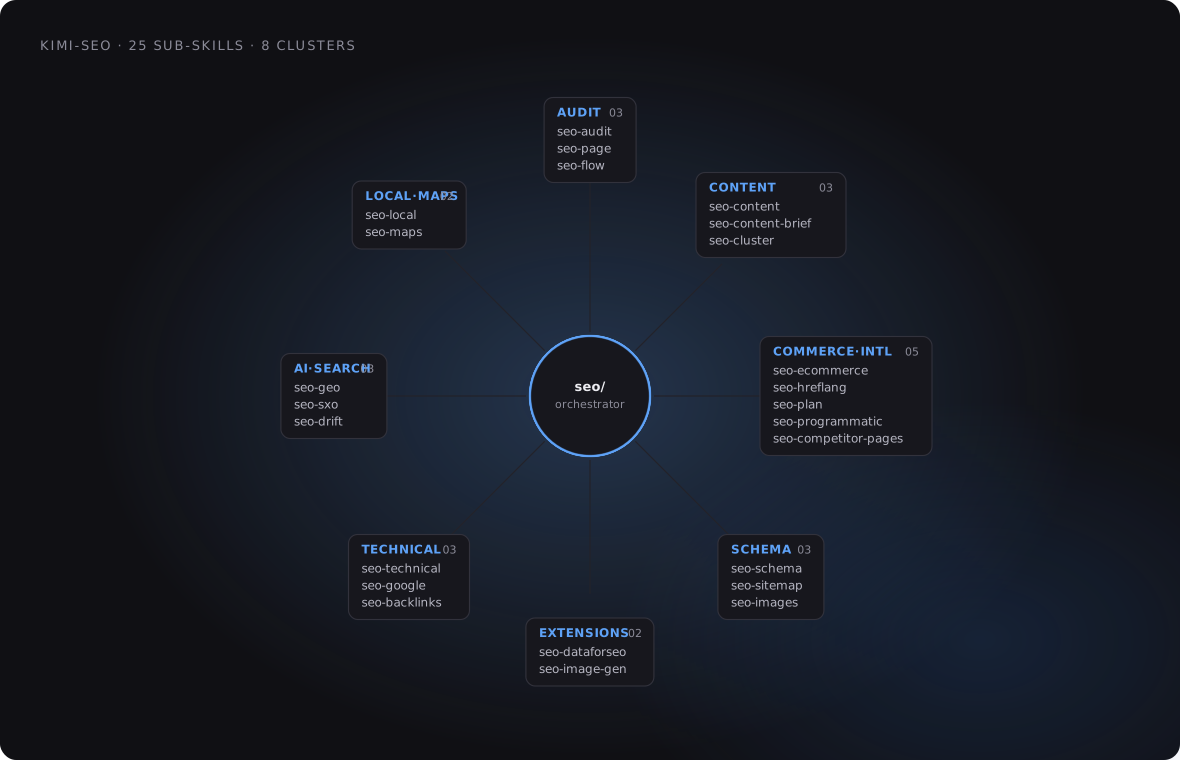
32 user-invocable /kimi-seo:seo commands across the orchestrator, its sub-skills, and 8 MCP extensions. Full reference in docs/COMMANDS.md.
| Command | Description |
|---|---|
/kimi-seo:seo setup |
Create or refresh the isolated Python runtime and Chromium |
/kimi-seo:seo doctor |
Check runtime readiness without changing the system |
/kimi-seo:seo audit <url> |
Full website audit with parallel sub-agent delegation |
/kimi-seo:seo page <url> |
Deep single-page analysis |
/kimi-seo:seo technical <url> |
Technical SEO audit across 9 categories |
/kimi-seo:seo content <url> |
E-E-A-T and content quality analysis |
/kimi-seo:seo content-brief <topic> |
Detailed content brief: target keywords, outline, internal links |
/kimi-seo:seo schema <url> |
Detect, validate, and generate Schema.org markup |
/kimi-seo:seo geo <url> |
AI Overviews / Generative Engine Optimization |
/kimi-seo:seo sitemap <url | generate> |
Analyze or generate XML sitemaps |
/kimi-seo:seo images <url> |
Image optimization analysis |
/kimi-seo:seo plan <type> |
Strategic SEO planning (saas, local, ecommerce, publisher, agency) |
/kimi-seo:seo programmatic <url> |
Programmatic SEO analysis and planning |
/kimi-seo:seo competitor-pages <url> |
Competitor comparison page generation |
/kimi-seo:seo local <url> |
Local SEO analysis (GBP, citations, reviews, map pack) |
/kimi-seo:seo maps [command] |
Maps intelligence (geo-grid, GBP audit, reviews, competitors) |
/kimi-seo:seo hreflang <url> |
Hreflang / i18n SEO audit and generation |
/kimi-seo:seo google [command] |
Google SEO APIs (GSC, PageSpeed, CrUX, Indexing, GA4, PDF reports) |
/kimi-seo:seo backlinks <url> |
Backlink profile analysis (Moz, Bing, Common Crawl) |
/kimi-seo:seo cluster <keyword> |
SERP-based semantic clustering |
/kimi-seo:seo sxo <url> |
Search Experience Optimization (page-type, user stories, personas) |
/kimi-seo:seo drift baseline | compare | history <url> |
SEO drift monitoring with SQLite snapshots |
/kimi-seo:seo ecommerce <url> |
E-commerce SEO and marketplace intelligence |
/kimi-seo:seo flow [stage] |
FLOW framework prompts (CC BY 4.0, evidence-led) |
/kimi-seo:seo firecrawl [command] <url> |
Full-site crawling (extension) |
/kimi-seo:seo dataforseo [command] |
Live SEO data (extension) |
/kimi-seo:seo image-gen [use-case] |
AI image generation for SEO assets (extension) |
/kimi-seo:seo ahrefs [command] <url> |
Backlinks, organic keywords, and content data via the official Ahrefs MCP (extension) |
/kimi-seo:seo seranking [command] |
AI Share-of-Voice across ChatGPT, Gemini, Perplexity, AI Overviews, AI Mode (extension) |
/kimi-seo:seo profound [command] |
LLM citation tracking with time-series data (extension) |
/kimi-seo:seo bing [command] <url> |
Bing Webmaster Tools + IndexNow URL submission (extension) |
/kimi-seo:seo unlighthouse <url> |
Multi-page Lighthouse runner, runs locally (extension) |
Features
What Core Web Vitals does Kimi SEO check?
It measures the three metrics Google ranks on today: LCP — how fast the main content loads (target: under 2.5s), INP — how fast the page reacts to clicks and taps (target: under 200ms), and CLS — how much the layout jumps (target: under 0.1). When real-user data exists it comes from the Chrome User Experience Report (CrUX), including a 25-week history; otherwise it falls back to a Lighthouse lab run. LCP can be split into subparts (TTFB, load delay, load duration, render delay) to pinpoint the bottleneck. Mobile and desktop are measured separately. (INP replaced FID in 2024 — Kimi SEO never reports FID.)
How does Kimi SEO assess E-E-A-T?
E-E-A-T is Google's quality lens — Experience, Expertise, Authoritativeness, Trustworthiness — from the Search Quality Rater Guidelines (September 2025 update). In plain terms: Experience is proof you did the thing (original research, case studies, first-hand photos). Expertise is credentials and depth. Authoritativeness is others citing you. Trustworthiness — weighted the most — is contact info, HTTPS, corrections, date stamps. Before scoring, Kimi SEO applies Google's own Who / How / Why check from the helpful-content guide. AI-written content is fine when it's helpful; it becomes spam when used to mass-produce thin pages, which seo-content humanize and seo-content verify are built to catch.
What Schema.org types does Kimi SEO support?
JSON-LD, the format Google prefers. Kimi SEO detects, validates, and generates the active types — organization, article, product, local, event, job, course, software, service, Q&A, video (full list: schema-types.md). Just as important, it tracks what Google retired so you don't ship dead markup: HowTo (2023), ClaimReview, VehicleListing, EstimatedSalary, LearningVideo, SpecialAnnouncement, CourseInfo carousel (2025), and FAQ rich results (retired for all sites May 7, 2026). What to use instead: deprecated-types-2024-2026.md.
How does Kimi SEO optimize for AI search?
Short version: "AI SEO" is just SEO. Per Google's AI Optimization Guide, AI Overviews and AI Mode run on the same ranking systems as classic search — if your page is indexed and snippet-eligible, it can appear in AI features. So Kimi SEO scores what actually helps: self-contained answer blocks (134-167 words), question-shaped headings, clear attribution, structured data, and brand presence on Wikipedia, Reddit, YouTube, and LinkedIn. And it tells you what not to waste time on, with primary-source evidence: llms.txt is not a citation lever, content chunking is not required, and AI-specific keyword rewrites are unnecessary (evidence).
Which Google SEO APIs does Kimi SEO integrate with?
None are required — you start with zero keys and add data in tiers when you want it:
| Tier | Credentials | APIs Unlocked |
|---|---|---|
| 0 | API key | PageSpeed Insights, CrUX, CrUX History (25-week trends) |
| 1 | + OAuth or Service Account | + Search Console (queries, URL Inspection, sitemap status), Indexing API |
| 2 | + GA4 property config | + GA4 organic traffic, top landing pages, device / country breakdown |
| 3 | + Ads developer token | + Keyword Planner search volume and competition data |
Setup wizard: /kimi-seo:seo google setup. Credentials live in ~/.config/kimi-seo/ with owner-only permissions — never in the repo. PDF reports (A4 layout, matplotlib charts) are generated with WeasyPrint.
How does Kimi SEO handle local SEO?
Three layers: your Google Business Profile (categories, hours, photos, posts, products), NAP consistency (name / address / phone matched across directories, with deviations flagged), and review intelligence (rating trends, sentiment, response coverage). Multi-location sites get doorway-page guardrails: a warning at 30 location pages, a hard stop at 50. The /kimi-seo:seo maps workflow adds geo-grid rank tracking, GBP auditing, and competitor radius mapping. Schema generation covers LocalBusiness with geo coordinates, opening hours, and service area. A GBP deprecation linter also catches retired chat-field references and .business.site URLs.
Compared to manual / agency / commercial tools
The short version: a 10-15 minute audit, free and fully local, repeatable, no lock-in — and every finding comes with a way to check it. Details:
Full comparison table
| Manual audit | Agency engagement | Commercial SEO audit tool | Kimi SEO | |
|---|---|---|---|---|
| Time per audit | 4-8 hrs senior SEO time | 1-3 weeks turnaround | 10-45 min crawl + report | 10-15 min |
| Cost | High (billable hours) | $2k-$15k+ project | $99-$999/mo subscription | Free skill + Kimi Code subscription |
| Repeatable | Inconsistent across analysts | Inconsistent across engagements | Yes | Yes, deterministic + scriptable |
| Output format | Wall-of-findings PDF | Branded slide deck | Web dashboard, CSV exports | Markdown + PDF + JSON, local files |
| Custom benchmarks | Manual per analyst | Agency-specific frameworks | Vendor-fixed | Edit local SKILL.md |
| Data leaves machine? | No (your spreadsheet) | Yes (sent to agency) | Yes (uploaded to vendor) | No, fully local by default |
| Lock-in | None | High | High (data-exit friction) | None. MIT, your files. |
| AI search awareness | Depends on analyst | Depends on agency seniority | Lagging (typically 6-12 mo behind) | Google AI Optimization Guide (May 2026), Sept 2025 QRG, INP-not-FID, GEO/AEO=SEO reframe, llms.txt evidence-based posture |
| Falsifiability per finding | No | No | No | Yes. Every recommendation carries a "how would we know this failed?" check + leading indicator |
Cost benchmarks: manual audit assumes a senior SEO consultant at typical agency billable rates; agency engagement based on common discovery/audit deliverable scopes; commercial-tool subscriptions reflect published mid-tier pricing across the SEO audit category (Ahrefs, Semrush, Sitebulb, Screaming Frog). Your numbers may differ.
Use cases
SEO agency lead, 10 client sites. A /kimi-seo:seo audit per client every Monday replaces the quarterly deep dive. The client health-score email drops from 4 hours to 12 minutes, and drift baselines catch regressions between runs — the conversation becomes "here's what changed this week," not "here's a snapshot."
In-house SEO lead at a SaaS company. Run the audit 24 hours before each quarterly review. It catches what dashboards bury — broken canonical chains, retired schema, AI-citability gaps, expired-domain heritage — before the CMO asks why traffic dipped.
Freelance consultant on a discovery call. Run the audit live. You walk out with a real 0-100 score and prioritized critical findings — proof of value during the call, not after the proposal.
Sample Output
Kimi SEO writes real markdown reports as its primary deliverable. Below is the first ~50 lines of a /kimi-seo:seo schema https://example.com/about audit verbatim. The actual structure, headers, and grading format the plugin produces follows.
SCHEMA-REPORT.md: first 50 lines of a real audit
# Schema Markup Report: example.com/about

**URL:** https://example.com/about
**Date:** 2026-02-09
**Format Detected:** JSON-LD (3 blocks) | No Microdata | No RDFa

---

## Summary

| Metric | Value |
|--------|-------|
| **JSON-LD Blocks** | 3 |
| **Schema Types** | Organization, WebSite, SoftwareApplication |
| **Critical Issues** | 2 |
| **Warnings** | 5 |
| **Passed Checks** | 18 |
| **Overall Grade** | B+ (solid foundation, actionable gaps) |

---

## Existing Schema Validation

### 1. Organization (`@id: #organization`)

| Property | Value | Status | Notes |
|----------|-------|--------|-------|
| `@context` | https://schema.org | Valid | |
| `@type` | Organization | Valid | Active type |
| `@id` | https://example.com#organization | Good | Enables cross-referencing |
| `name` | Example | Valid | |
| `description` | Present, 200+ chars | Good | Descriptive and keyword-rich |
| `url` | https://example.com | Valid | Absolute URL |
| `logo` | ImageObject with @id, url, width, height, caption | Excellent | Well-structured |
| `foundingDate` | "2024" | Imprecise | Year-only accepted but ISO 8601 preferred |
| `areaServed` | "Worldwide" | Text | Works but `GeoShape` is more semantic |
| `contactPoint` | email + contactType | Valid | Consider adding `telephone` |
| `founder` | 1 Person (Jane Doe) | Incomplete | Page describes two co-founders; second missing |
| `sameAs` | 5 social profiles | Good | GitHub, X, LinkedIn, YouTube, Reddit |
| `knowsAbout` | 6 topics | Good | Relevant topical signals |

**Critical Issue:** The `founder` property only includes Jane Doe. John Smith (Co-Founder & Technical Director) is displayed on the page but absent from the schema. This creates a content-schema mismatch that can confuse search engines.
Other audit outputs follow the same shape: FULL-AUDIT-REPORT.md (umbrella audit), GEO-ANALYSIS.md (AI-search readiness), LOCAL-SEO-ANALYSIS.md (GBP and citations), and a production PDF via WeasyPrint + matplotlib (cover, TOC, executive summary, data sections, recommendations, methodology, roughly 32 A4 pages for a full site audit).
Architecture
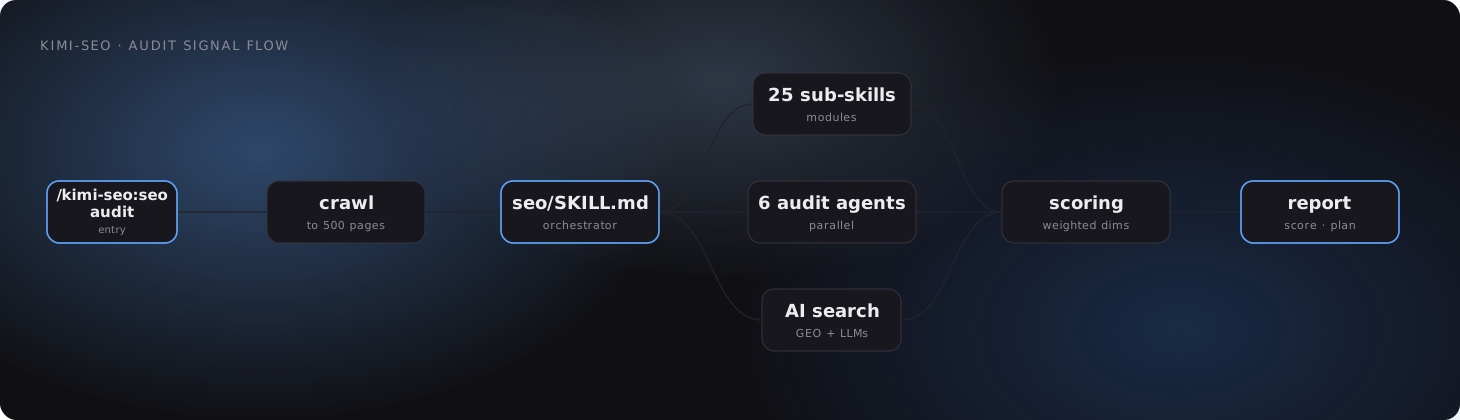
The plugin follows the open Agent Skills standard (SKILL.md format) with a 3-layer architecture (directive, orchestration, execution). Skills and agents are auto-discovered from skills/seo-*/ and agents/seo-*.md. The orchestrator (skills/seo/SKILL.md) handles industry detection (SaaS, local, ecommerce, publisher, agency), parallel sub-agent dispatch up to 15 simultaneously, and synthesis through the 10-principle framework before emitting the action plan. Full architecture: docs/ARCHITECTURE.md.
Methodology
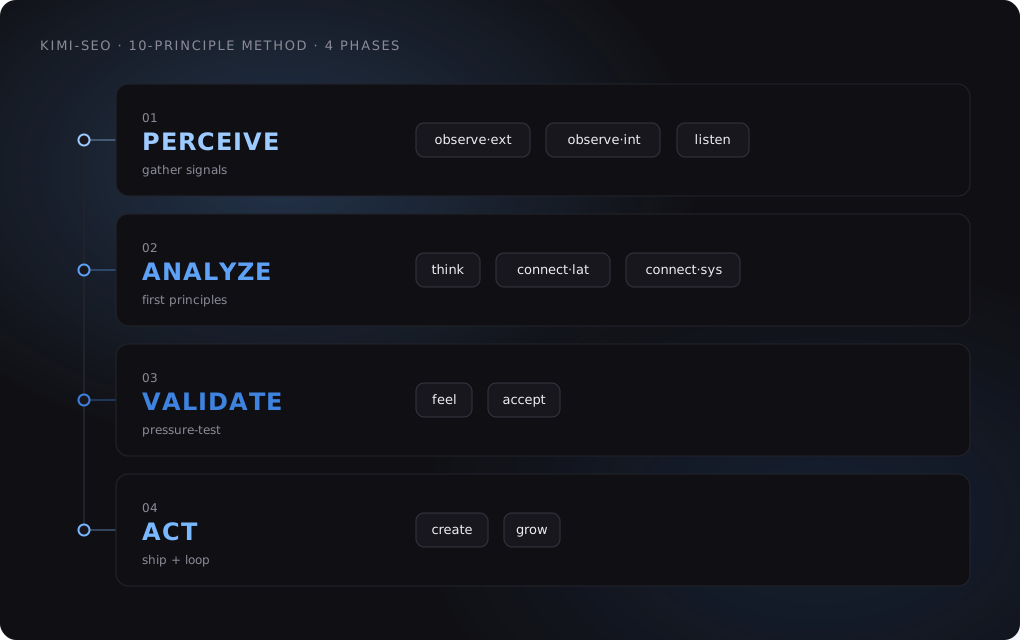
Every audit walks 10 principles grouped into four phases. Each emitted recommendation carries four fields: the first-principle observation it rests on, its dependency relationship to other recommendations, a "how would we know this failed?" check, and a leading indicator to monitor.
| Phase | Principles | What it does |
|---|---|---|
| PERCEIVE | OBSERVE (external) · OBSERVE (internal) · LISTEN | Collect raw signals; audit your own assumptions; read what the SERP, the brand voice, and the community actually say |
| ANALYZE | THINK · CONNECT (lateral) · CONNECT (system) | Reduce to first principles; find non-obvious cross-skill links; sequence into a dependency graph |
| VALIDATE | FEEL · ACCEPT | Pressure-test against UX, brand voice, operator capacity; surface falsifiability |
| ACT | CREATE · GROW | Ship the artifact; set the feedback loop for the next audit |
Full methodology: skills/seo/references/thinking-framework.md.
Limitations
Two boundaries worth knowing up front.
Some JavaScript-heavy pages still read noisy. The built-in headless renderer handles most SPAs, but pages that load key content on scroll or after a click (modals, tabs) can confuse it. For those, compare the seo-visual Playwright snapshot against the raw-HTML findings.
No keys, no field data. Without Google credentials, Core Web Vitals are lab estimates and indexation is inferred from page signals. Everything still works — the numbers are just less authoritative. Paid extensions (Ahrefs, DataForSEO, SE Ranking, Profound) similarly need their own accounts.
Requirements
- Python 3.10+
- Kimi Code CLI
- Optional: Playwright Chromium — install.sh offers to install it (you can skip the prompt); needed only for SPA rendering and screenshots
- Optional: Google API credentials for enriched CWV / GSC / GA4 data (see
/kimi-seo:seo google setup)
Uninstall
Plugin install (recommended method):
/plugins remove kimi-seo
/reload
Manual install:
git clone --depth 1 --branch kimi https://github.com/bentocodeing/kimi-seo.git
bash kimi-seo/uninstall.sh
One-liner (curl)
curl -fsSL https://raw.githubusercontent.com/bentocodeing/kimi-seo/kimi/uninstall.sh | bash
Extensions
Optional MCP servers add live data to the audit pipeline. Kimi SEO ships extensions for 8 servers; the plugin core works without any of them.
DataForSEO
Live SERP data, keyword research, backlinks, on-page analysis, content analysis, business listings, AI visibility checks, and LLM mention tracking. 23 data commands across 9 API modules.
./extensions/dataforseo/install.sh   # requires DataForSEO account
/kimi-seo:seo dataforseo serp best coffee shops
/kimi-seo:seo dataforseo ai-mentions your brand
Full DataForSEO docs: extensions/dataforseo/README.md.
Firecrawl
Full-site crawling and URL discovery via the Firecrawl MCP server.
./extensions/firecrawl/install.sh
/kimi-seo:seo firecrawl crawl https://example.com
Full Firecrawl docs: extensions/firecrawl/README.md.
Banana: AI image generation
SEO image generation (OG previews, blog heroes, product photos, infographics) via the Banana Creative Director pipeline.
./extensions/banana/install.sh
/kimi-seo:seo image-gen og "Professional SaaS dashboard"
Full Banana docs: extensions/banana/README.md.
Ahrefs, SE Ranking, Profound, Bing Webmaster, Unlighthouse
Five more extensions:
- Ahrefs: official
@ahrefs/mcpserver with backlink and organic data - SE Ranking: AI Share-of-Voice across ChatGPT, Gemini, Perplexity, AI Overviews, AI Mode
- Profound: LLM citation tracker with time-series data
- Bing Webmaster: Bing Webmaster Tools plus IndexNow unified
- Unlighthouse: MIT-licensed multi-page Lighthouse runner
Setup walkthroughs live under extensions/<name>/docs/; integration notes: docs/MCP-INTEGRATION.md.
Ecosystem
Kimi SEO sits in a small ecosystem of related projects it interoperates with:
| Project | What it does | How it connects |
|---|---|---|
| Kimi SEO | SEO analysis, audits, schema, GEO | Core. Analyzes sites and generates action plans. |
AgriciDaniel/claude-seo |
The upstream project this fork tracks | Origin of the SEO workflow; the fork's main branch mirrors its releases. |
| FLOW | Evidence-led SEO framework (41 AI prompts, CC BY 4.0) | Knowledge base. Powers seo-flow prompts. |
Workflow example:
/kimi-seo:seo audit https://example.com: identify content gaps and technical issues/kimi-seo:seo backlinks https://example.com: analyze link profile and competitor gaps/kimi-seo:seo geo https://example.com/blog/post: score AI-citation readiness/kimi-seo:seo content-brief "target keyword": produce a brief for the next post/kimi-seo:seo image-gen hero "blog topic": generate hero image (Banana extension)
Documentation
- Getting Started: install to first fixed issue in 10 minutes — start here
- Installation Guide
- Commands Reference: every
/kimi-seo:seocommand in depth - Architecture: 3-layer design, auto-discovery, parallel dispatch
- MCP Integration: integration notes; extension setup lives under
extensions/<name>/docs/ - Troubleshooting
- Contributors: community credits
FAQ
What is Kimi SEO?
An open-source SEO plugin for Kimi Code: 25 sub-skills that audit technical SEO, content quality, schema, AI search, local, e-commerce, and international SEO, then hand you a prioritized action plan where every recommendation carries a "how would we know this failed?" check. MIT-licensed, no tracking, works with zero API keys (audits do fetch the URLs you point at). Aligned with Google's AI Optimization Guide and the September 2025 Quality Rater Guidelines.
How is Kimi SEO different from Screaming Frog or Ahrefs Site Audit?
They complement it, not compete. Screaming Frog is a better raw crawler; Ahrefs owns the backlink data (Kimi SEO integrates via its extension instead of duplicating it). Kimi SEO's edge is the workflow: it's conversational and LLM-native, so you audit, ask follow-ups, and fix in the same session — free, MIT-licensed, and every finding ships with a falsifiability check.
Does Kimi SEO work on single-page applications (Next.js, React, Vue)?
Yes. A shared headless renderer (scripts/render_page.py, Playwright Chromium) auto-detects SPA shells — an empty <div id="root">, a single bundle script — and renders before auditing. Plain sites skip rendering and go over raw HTTP. Content extraction uses trafilatura; publication dates come from htmldate. Pages that load content on scroll or after clicks can still read noisy — see Limitations.
What Google APIs does Kimi SEO use, and are they required?
None are required. Add credentials in tiers when you want real field data: an API key unlocks PageSpeed and CrUX; OAuth adds Search Console and the Indexing API; GA4 config adds organic traffic; an Ads developer token adds Keyword Planner volumes. Wizard: /kimi-seo:seo google setup. Credentials live in ~/.config/kimi-seo/ with owner-only permissions and never leave your machine except to Google's own endpoints.
Is Kimi SEO free?
Yes. MIT, no per-domain pricing, no telemetry, no quotas imposed by the plugin. The core and all 25 sub-skills work without any paid service. Optional extensions wrap paid services (DataForSEO, Ahrefs, Profound, SE Ranking) using your own accounts — the plugin works fully without them. Google's APIs are free within normal account quotas.
How is Kimi SEO different from regular SEO tools when it comes to AI search?
It follows Google's own position: "AEO" and "GEO" are rebranded SEO, not a separate discipline. So no llms.txt tricks, no content chunking, no AI-specific keyword rewrites — Kimi SEO scores the things with evidence behind them (citability, question-shaped headings, attribution, entity presence on Wikipedia, Reddit, YouTube, LinkedIn). For commerce sites it also checks the IPTC TrainedAlgorithmicMedia flag Google Merchant Center requires on AI-generated product images.
Community Contributors
Kimi SEO (this fork)
No community contributors yet — be the first. See CONTRIBUTING.md for how to get involved.
Claude SEO (upstream: AgriciDaniel/claude-seo)
Kimi SEO is based on claude-seo. The upstream v1.9.0 release included contributions from the AI Marketing Hub Pro Hub Challenge, which this fork inherits:
| Contributor | Contribution |
|---|---|
| Lutfiya Miller (Winner) | Semantic Cluster Engine → seo-cluster |
| Florian Schmitz | SXO Skill → seo-sxo |
| Dan Colta | SEO Drift Monitor → seo-drift |
| Chris Muller | Multi-lingual SEO → seo-hreflang enhancements |
| Matej Marjanovic | E-commerce + DataForSEO Cost Config → seo-ecommerce + cost guardrails |
See CONTRIBUTORS.md for full details and original repo links.
License
MIT License. See LICENSE for details.
Contributing
Contributions welcome. Please read CONTRIBUTING.md before submitting PRs and include the tests or checks you ran in the PR description.
Author
Kimi SEO is created and maintained by bentocodeing.
Kimi SEO is based on claude-seo, created by Agrici Daniel, AI Workflow Architect. Full credit for the original SEO workflow goes to him and the upstream contributors:
- Blog: deep dives on AI marketing automation
- AI Marketing Hub (free): open community
- AI Marketing Hub Pro: Pro community, early access to this skill
- YouTube: tutorials and demos
- GitHub: all open-source tools